
Introduction
The choices we make about our land today will shape our future: the health of our environment and the resilience of our communities against climate breakdown. With biodiversity in decline, ecosystems under pressure and extreme weather events becoming more frequent, urgent action is needed to recover the natural world on which we all depend.
The climate and nature emergencies are inseparable – they must be addressed together. Restoring nature is essential if Scotland is to adapt to accelerating climate breakdown. To give nature the best possible chance of bouncing back, we must rewild at scale and at speed. Rewilding – the large-scale restoration of ecosystems and natural processes – offers hope in the face of crisis, and brings a cascade of benefits for people across Scotland.
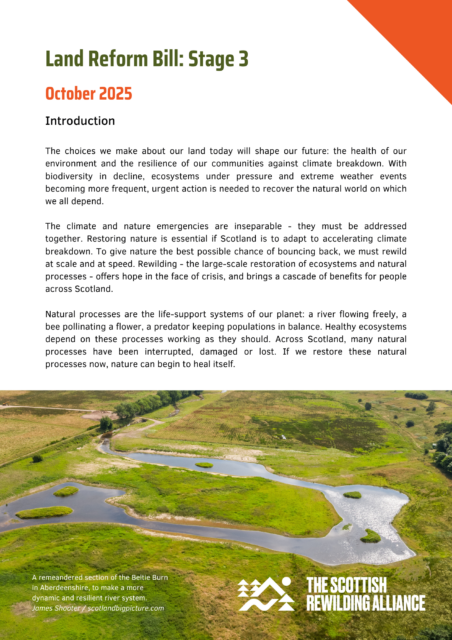
Natural processes are the life-support systems of our planet: a river flowing freely, a bee pollinating a flower, a predator keeping populations in balance. Healthy ecosystems depend on these processes working as they should. Across Scotland, many natural processes have been interrupted, damaged or lost. If we restore these natural processes now, nature can begin to heal itself.
How Scotland’s land is owned and managed affects our ability to restore nature and build climate resilience. Reform is urgently needed to unlock more inclusive, locally driven restoration, giving people across Scotland a greater stake, and greater say, in a wilder future.
Amidst the climate and nature emergencies, restoring Scotland’s natural environment must be at the heart of the legislation we make today. We need a Scotland where land is owned, managed and used in ways that are fit for the future – a Scotland where nature and people can thrive together.
We support…
Amendment 124 in the name of Ariane Burgess MSP
The Natural Environment Bill will amend the Nature Conservation (Scotland) Act 2004 to allow the creation of statutory targets for nature recovery. This amendment ensures that Scotland’s largest landowners lay out in Land Management Plans how they contribute to these nature recovery targets, aligning the Land Reform Bill provisions with the Natural Environment Bill targets.
In the Bill as drafted, the Scottish Government can create secondary legislation that imposes obligations on the owners of large landholdings to publish land management plans. Scotland’s largest landholdings have a pivotal role to play in repairing Scotland’s biodiversity, mitigating against the effects of climate breakdown and enabling Scotland to adapt to a changing climate. It is therefore essential that this is underlined in the requirements for land management plans. There are 623 landholdings in Scotland over 3,000 hectares, comprising 40% of Scotland’s land area. We have identified just 19 landholdings over 3,000 hectares restoring natural processes at scale. While there are probably more large estates working to restore nature, the lack of corresponding land management plans makes data collection difficult.
Some policy, legislation and funding levers do exist to encourage large landowners to restore nature at scale. But adding this requirement to the Land Reform Bill would underline the importance of restoring natural processes in response to the climate and nature emergencies.
Amendment 123 in the name of Ariane Burgess MSP
The Scottish Rewilding Alliance supports the amendment proposed to remove the phrase “or sustaining” from the wording of the Land Reform Bill in relation to land management plans. This shifts the focus of land management from simply maintaining the status quo, to actively improving the condition of the land. In a nature and climate emergency, “sustaining” degraded ecosystems on large landholdings is not enough — we need meaningful restoration that brings back natural processes and ecological function.
Across much of Scotland, land is locked in a degraded or simplified state, often stripped of native vegetation, drained, overgrazed, or heavily managed in ways that suppress biodiversity and hinder the return of natural processes.
Removing “or sustaining” helps ensure that land management plans are progressive and ambitious, encouraging landowners and managers to think about how their actions can have specific benefits: improving soil health, restoring habitats, bringing back native species, and supporting the dynamic processes that make ecosystems resilient and productive. It also aligns with Scotland’s broader commitments to a just transition, biodiversity targets, and nature-based solutions to climate change.
Amendment 317 in the name of Mark Ruskell
The Scottish Rewilding Alliance supports this amendment because it ensures that licences for killing or taking certain birds cover not only the specific sites where such activities occur but also the surrounding contiguous land under the same ownership or occupation. This broader definition of licensed land is crucial for effective oversight and enforcement, as it helps prevent the displacement of harmful practices to nearby areas and closes loopholes that could allow offences to go unchecked.
Amendment 323 in the name of Ariane Burgess MSP
Informal buildings, or huts, are important for a number of reasons. They provide a base for outdoor activity; they allow us to better understand the carrying capacity of the environment; they encourage the development of new skills; they provide a platform for creating cohesive communities; and they contribute to sustainable rural development.
Currently, no government-endorsed model lease exists for public bodies seeking to create plots of land for hutting. A lease has been trialled at Carnock, in South-West Fife, to enable a group of hutters to build 12 huts on the national forest estate. This could form the basis of a model lease agreement to be used by other public bodies.
Amendment 206 in the name of Ariane Burgess MSP
This amendment reduces the peatland depth threshold for muirburn licensing to 30cm from 40cm. Deep peat is particularly vulnerable to damage from burning, releasing significant amounts of stored carbon and harming biodiversity. Setting the threshold at 30cm provides a clear, science-based limit that balances environmental protection with the realities of land management, helping to prevent unintended peat degradation while allowing responsible, controlled burning on shallower soils. Aligning Scotland’s rules with England also promotes consistency across the UK, making compliance simpler for cross-border landowners.
We do not support…
Amendments 204 and 205 in the name of Tim Eagle MSP
These amendments repeal the muirburn licensing scheme. The as-yet untested licensing system will regulate the controlled burning of heather and other vegetation, helping prevent wildfires, protect peatland and safeguard biodiversity. Removing the licensing scheme would be a backwards step, creating confusion and undermining efforts to balance land management, wildlife conservation and climate resilience.
What’s missing from the Land Reform Bill?
Scotland is one of the most nature-depleted countries in the world. Land reform during a nature emergency should aim to improve this situation – not maintain the status quo.
This bill is a missed opportunity to tackle the joint nature and climate crises.
At Stage 2, we strongly supported amendments that would have included nature recovery for landowners in land management plans.
The Scottish Government’s review of Community Rights to Buy will not conclude until December 2025, meaning there is no opportunity to incorporate its findings into this Land Reform Bill This is a missed opportunity, as the existing rights to buy vacant, derelict or abandoned land – and the right to buy land for sustainable development – do not adequately support communities that wish to purchase land for nature restoration. Communities can play an important role in restoring natural processes beyond land ownership, often in partnership with other organisations. However, owning land remains a key way to empower nature-focused communities. With better access to land, such communities could make a meaningful contribution to tackling the nature crisis while also improving their own sustainability, at both local and landscape scales.
We suggest introducing a new ‘Community Right to Buy for the Restoration of Nature’ or ensuring that the Right to Buy Land to Further Sustainable Development is, in the future, extended to explicitly cover nature restoration.
The high cost of buying land is a major barrier for people and communities who want to restore nature. The Scottish Government previously committed to double the Scottish Land Fund to £20 million but this has not happened. Even if it did, large-scale land purchases for the purpose of nature recovery would still be hard to fund. Where a community land purchase would both make the community more sustainable and be in the public interest, there should be exploration of a mechanism to discount the sale of land for the purposes of nature recovery.