
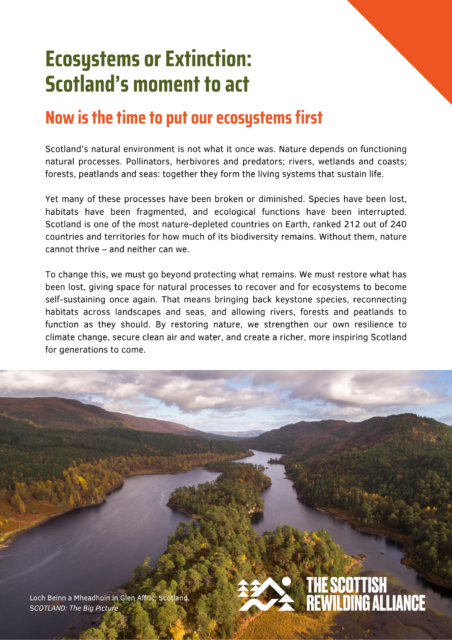
Ecosystems or Extinction: Scotland’s moment to act
Now is the time to put our ecosystems first
Introduction
We want to see the restoration of 30% of Scotland’s land and sea. That means healthy, functioning, connected ecosystems across 30% of our natural environment that sustain the complex web of life – including us. A working ecosystem is like a finely tuned machine, where every species, habitat and process keeps the whole system running. When parts of the machine are damaged, broken or missing entirely, it stops working. It might look OK from the outside – but we can all tell that it’s spluttering to a halt.
Nature depends on a working ecosystem made up of healthy populations of species, diverse habitats and functioning natural processes. Pollinators, herbivores and predators; rivers, wetlands and coasts; forests, peatlands and seas: together they form the living systems that sustain life.
Scotland is one of the most nature-depleted countries on Earth, ranked 212 out of 240 countries and territories for how much of its biodiversity remains. The time for half-measures and timid policies is long over. It’s time for radical, necessary action.
Statutory nature targets are critical for the restoration and rewilding of Scotland. But the actions that the next Scottish Government takes in support of those targets is what will make or break the future of Scotland’s natural environment.
Now is the time to take an ecosystem approach to how we tackle the climate and nature crises. A new report by the British Ecological Society and National Trust makes clear that human wellbeing over the coming years and decades will not depend on the extinction or abundance of particular wild species in particular places, but on ecosystems that are in full working order.
We welcome all amendments that seek to strengthen the Natural Environment Bill for nature. Below we have outlined those amendments that would help to bring an ecosystem-based approach to the recovery of Scotland’s nature.
We strongly support…
IN SECTION 1
Amendment 42 in the name of Mercedes Villalba to add the restoration of natural processes to the list of target topics. The health of our ecosystems depends on the proper function of ecological processes.
An ecosystem is not just a list of habitats and species. It is a dynamic system powered by the interactions between all the different parts of an ecosystem. Natural processes on land and at sea can include:
- Grazing and browsing: herbivores feeding on plants, shaping vegetation structure and succession
- Predation and trophic interactions: predators interacting with prey populations and contributing to ecosystem balance
- Seed dispersal and pollination: movement of seeds and pollen by wildlife, wind or water
- Hydrological flows and flooding: movement of water through rivers, wetlands and soils
- Succession and disturbance: natural changes in habitat over time, including events like treefall, storms or erosion
- Peat formation and wetland water regulation: accumulation of organic materials and water retention
- Coastal and tidal processes: movement of sediments and tides, shaping shorelines and intertidal habitats
- Ecosystem engineering: some species exert a disproportionate influence on their surroundings, like mycorrhizal fungi, native oysters, wood ants and beavers
- Nutrient cycling and decomposition: the movement and transformation of chemical elements through plants, animals, the breaking down of organic material or movement through water
- Primary productivity and photosynthesis: the production of organic matter and oxygen by green plants, algae and some bacteria
- Migration and seasonal movement: animals moving seasonally, connecting habitats and transporting nutrients
Despite large areas of Scotland’s land being managed for conservation, biodiversity continues to decline and species are still threatened with extinction. Ecological change in Scotland is often related to broken or disrupted natural processes. For example:
- Imbalance in grazing, e.g. overpopulation of herbivores, arrests natural tree regeneration, reducing habitat for other species and compromising carbon sequestration and soil stabilisation
- Rivers disconnected from their floodplains stops the natural flow of water in the landscape, disrupting nutrient cycling and removing spawning grounds and juvenile habitat for river species e.g. Atlantic salmon
- Drained, overgrazed or degraded peatlands allow peat to dry out, causing exposed peat to be oxidized by microbes and release stored carbon, contributing to climate breakdown while harming bog vegetation and increasing soil erosion
Rewilding focuses on restoring natural processes and proper ecosystem function, providing a way forward for ecologically degraded areas beyond restoration.
This aligns with the Kunming-Montreal Global Biodiversity Framework, which includes a commitment to restore at least 30% of degraded terrestrial, inland water, coastal, and marine ecosystems by 2030. The EU Nature Restoration Law refers to “allowing ecosystems to develop their own natural dynamics”. Introducing natural processes into the draft Natural Environment Bill will enable secondary legislation creating targets on the topic of natural processes to be introduced.
Amendment 168 in the name of Ariane Burgess adding the status of missing native species, in particular the Eurasian lynx, into the list of target topics.
The reintroduction of missing native species is a key action to deliver nature recovery, so is appropriate to include as a target topic. The reintroduction of keystone species such as the Eurasian lynx would help to restore balance to our ecosystems.
Lynx are forest-dwelling cats about the size of a labrador, thought to have become extinct in Scotland during the Middle Ages (around 1000 years ago) due to habitat destruction, prey decline and hunting. They are not dangerous to humans. They eat mostly roe deer but also Sika deer, hares, red squirrels, foxes and other species.
NatureScot’s Species Reintroduction Code (2014, updated 2021) says that reintroductions must be ecologically justified, have stakeholder support, and meet IUCN guidelines.
Lynx would benefit Scotland’s wildlife, helping to restore biodiversity and improve the health of our ecosystems through their influence on various ecological processes. For example, their effect on the behaviour of some herbivores as part of predator-prey dynamics may allow for more natural regeneration within our woods
Scotland has international obligations that align well with restoring lynx to its forests. The Convention on Biological Diversity (CBD, 1992) asks parties to restore degraded ecosystems and promote the recovery of threatened species. The Aichi Targets – Kunming–Montreal Global Biodiversity Framework (2022) call for species recovery and reintroduction to restore ecosystem function. EU Habitats Directive Article 22(a) obliges states to study the desirability of reintroducing species, including lynx, that are native to their territory and where that might contribute to their conservation, following public consultation. European Court of Justice case law (e.g. C-6/04 Commission v UK, “Habitats case”) established that states must take “appropriate measures” to restore populations, potentially including reintroductions, if species are extirpated from their natural range and conditions are suitable. The return of lynx would also support Scotland’s targets to halt biodiversity loss by 2030, and reverse it by 2045.
Modelling shows that the Scottish Highlands has sufficient well-connected habitat to support a reintroduced population of lynx. During 2024, Lynx to Scotland completed a National Lynx Discussion, bringing together representatives from a wide range of key stakeholder groups including farmer and landowner organisations, gamekeepers, foresters, tourism operators and conservationists. This process resulted in a shared agreement between all participants to continue exploring the possibility of reintroducing lynx in the future.
Any future reintroduction of lynx would need to follow the established legal process, meaning a fully licensed, publicly supported, scientifically monitored and properly resourced reintroduction, accompanied by a responsible management framework.
LYNX REINTRODUCTIONS ACROSS EUROPE [box out]
- Eurasian lynx numbers reached critically low numbers in the early to mid 20th century due to hunting, habitat loss and prey depletion
- In Western Europe lynx neared local extinction, while in Central and Eastern Europe populations became severely reduced
- Lynx have slow dispersal rates so supplementary reintroductions are often needed to boost populations
- Successful reintroduction projects have included:
- Germany: reintroductions in the Harz, Bavarian Forest, and Palatinate Forest since the 1970s have established small, slowly growing populations, with further releases taking place 206 – 2019
- Poland: lynx returned to NW Poland from 2019
- Slovenia and Croatia: translocations to strengthen lynx population in cross-border project 2017 – 2023, stabilising the population
- Switzerland: lynx reintroduced in the 1970s, stable population now in the Alps and Jura
- France: lynx reintroduced in Jura and Vosges mountains in the 1970s to 1990s, small population slowly increasing but at risk
- Spain and Portugal: Iberian lynx recovery project ongoing from early 2000s has led to the Iberian lynx moving from ‘Endangered’ to ‘Vulnerable’ on the IUCN Red List
- Austria: lynx reintroduction began in the 1970s, populations established in some regions
We call on the Scottish Government to commit to a reasoned discussion about the reintroduction of lynx, following in the footsteps of our European neighbours.
Amendment 16 in the name of Sarah Boyack to establish a citizens assembly on biodiversity and ecosystems, with duties to make recommendations and report to the Scottish Parliament.
A citizens’ assembly would help create legitimacy, resolve conflicts and drive action for restoring ecosystems across Scotland. Radical action is required to restore our depleted ecosystems. By giving citizens a structured platform to learn about ecological science, debate competing perspectives and produce informed recommendations, the government can support fair but fast action for nature.
Amendment 18 in the name of Mark Ruskell to make the setting of targets by the Scottish Government mandatory.
The targets resulting from Scotland’s Natural Environment Bill will be set by secondary legislation. By the time commencement takes place and the next government has formed following the 2026 Holyrood elections, Scotland will be fast approaching its 2030 goal to halt biodiversity loss and be nature positive. Government and wider public sector delays on the management of Marine Protected Areas, increasing Scotland’s beaver population and other critical actions suggest that achieving these goals will be challenging.
Amendment 22 in the name of Mercedes Villalba to add ecological connectivity to the list of topics which nature recovery targets will cover.
Many species need to move between habitats to find food, mates and shelter. Fragmented habitats can lead to genetic bottlenecks and local extinctions. Connected habitats allow species to respond to changing climatic conditions, shifting their range as conditions change. Connectivity also supports natural processes such as pollination, seed dispersal and predator-prey dynamics, which are important for healthy ecosystems.
Without this topic, there is a risk that statutory targets will focus on habitat extent and species recovery. Increasing habitat area or species count alone is insufficient if patches are isolated. Connectivity targets ensure that spatial patterns of restoration are considered, not just total area.
Amendment 36 in the name of Lorna Slater to require targets relating to the restoration of at least 30% of degraded terrestrial, inland water, marine and coastal ecosystems.
The EU Nature Restoration Law, adopted in June 2024, sets legally binding targets for Member States to restore degraded ecosystems. By 2030, at least 20% of degraded land and sea areas must have restoration measures in place; by 2050, all degraded ecosystems must have restoration measures in place. This clear, understandable target will result in countries identifying their restoration needs and putting measures in place to meet these targets. Rewilding offers these states a clear and effective pathway to meeting their obligations. Rewilding Europe, together with other members of the European Rewilding Coalition, has drawn up and published a set of practical guidelines for drafting National Restoration Plans.
Amendment 43 in the name of Mercedes Villalba would ensure that both marine and terrestrial ecosystems are included in nature recovery targets.
Scotland’s marine environment is in decline. Action to address this – from management of Marine Protected Areas to protection of Priority Marine Features – has been repeatedly delayed. The recovery of marine ecosystems is often overlooked, but is vitally important to Scotland’s future. The amount of Scotland’s inshore waters in recovery is dangerously low, amounting to less than 1% of the total area.
As drafted, the Bill could also result in the setting of just three targets for nature recovery, all of which could relate to land. By including a requirement for both marine and terrestrial ecosystems, secondary legislation will set targets for the recovery of Scotland’s seas as well as land.
Amendment 44 in the name of Mercedes Villalba adds keystone species to the topics for nature recovery targets.
Keystone species are organisms that play a significant role in maintaining a healthy ecosystem. In Scotland, this might include ecosystem engineers, such as wood ants, native oysters, burrowing terrestrial mammals and beavers; wild grazers, including species lost to Scotland such as elk and bison; and apex predators, such as white-tailed eagles and lynx. These species fulfil vital ecological roles, maintaining the structure and biodiversity of ecosystems.
The absence or loss of keystone species can undermine ecosystems, leaving them unbalanced and less biodiverse. By including keystone species as a target topic, the Scottish Government can upscale its work on the reintroduction and reinforcement of ecologically necessary species.
We further suggest that including ‘threatened’ species might result in an approach which focuses restoration efforts only on the most critically threatened species, delaying action on other species until it is too late to act.
Amendment 46 in the name of Ariane Burgess requires the Scottish Government to set targets for both inshore and offshore marine habitats.
Inshore and offshore habitats are ecologically distinct, although interconnected. Species may span both zones, including at different parts of their life cycle. Additionally, policy frameworks distinguish between inshore and offshore environments, reflecting different legal responsibilities. These areas are also facing different pressures, and therefore require bespoke action to support their recovery.
Nature recovery targets must be tailored to the ecology, pressures and legal frameworks of each zone, otherwise actions may be ineffective.
Amendment 47 in the name of Ariane Burgess requires that targets be set which ensure an ecologically coherent network, using an integrated wholescape based approach.
An ecologically coherent network is a system of areas that are connected and functionally linked, ensuring that species can move, ecosystems can interact and natural processes can operate at scale. An integrated wholescape approach considers an entire landscape or seascape, sometimes both together, including protected areas, semi-natural and managed lands and different freshwater, coastal and marine systems. It recognises that ecosystems are dynamic and interconnected, while also balancing social and economic factors with ecological factors.
Amendment 103 in the name of Sarah Boyack sets out that the purpose of setting targets is to halt and reverse biodiversity loss in Scotland.
This is an important clarification that will better guide future governments by providing a clear rationale for subsequent target setting. This will help ensure that future Scottish governments cannot interpret targets narrowly without consideration of the wider ecological impact.
Amendment 169 in the name of Ariane Burgess MSP adds certain species of whales to the list of target topics, as regards their population size and extent.
Large cetaceans are keystone species in marine ecosystems and serve as indicators of ocean health. They contribute to nutrient cycling, carbon sequestration and, as predators, to trophic regulation. The actions that a future government might take in response to a nature recovery target focusing on whales would improve ecological health across the board.
Nature recovery is about restoring ecological function, not just species numbers. Where specific species are included in nature recovery targets, there must be a clear ecological rationale.
Amendment 170 in the name of Ariane Burgess MSP adds seagrass and kelp to the list of target topics, as regards the extent of such habitats.
Both seagrass and kelp are keystone species in Scotland’s marine ecosystems, sporting the entire structure of coastal and inshore food webs. The loss or degradation of these species reduces the resilience of our ecosystems, harms biodiversity – including commercially significant species – and holds back natural carbon sequestration.
The scale of the loss of seagrass from Scotland’s waters is astounding. Modelling suggests that there has been a decline of up to 92% in some areas, with a documented loss of up to 44% across the UK. Remaining kelp populations in Scotland appear stable, but ongoing ocean warming, storms and invasive species are significant threats.
By introducing targets focused on the extent of these important species, action will be focused on their urgent recovery and benefit the wider ecosystem in the process.
Amendment 173 in the name of Ariane Burgess MSP requires the government to set a target that restricts demersal mobile fishing gear in at least 30% of Scotland’s inshore waters. Fishing gear that makes contact with the seabed disturbs important habitats such as seagrass, kelp, maerl and oyster, impacting on the species that live and breed in these habitats. By restricting destructive fishing gear in at least 30% of inshore waters, where most key habitats for the spawning and nursing of fish populations are, populations of commercially and ecologically important species can recover – benefitting biodiversity, sustainable fishing and coastal communities.
SECTION 5
National parks should be exemplars of nature recovery, supporting people, nature and climate. We support the amendments in this section that seek to improve national parks for nature, but regret that there has not been more ambition for Scotland’s national parks.
Scotland’s national parks should be trailblazers when it comes to nature recovery, pioneering new approaches, working with stakeholders and exploring how communities can participate in and benefit from nature’s return. To empower them to do so, it is vital that this mission is clear and understood by those working for, and with, our national parks. We are therefore disappointed to see that Scotland’s national parks will be equipped only with minor changes to their aims, rather than an overarching purpose of nature recovery.
In a paper submitted to NatureScot’s National Park Stakeholder Advisory Group in 2022, three options for change were outlined. Minor change; significant change; and step change. Despite the need for urgent action and the potential of our national parks to help tackle the dual nature and climate crises, the Scottish Government has selected the minor change option.
We support the rewording of existing aims to better reflect other changes to the vision and mission of our national parks. However, we believe that the government’s decision to drop the proposed overarching purpose for Scotland’s national parks, which the majority of stakeholders supported in the consultation, will have damaging consequences for nature. NatureScot’s advice to ministers in February 2023 said that in the consultation, “There was strong and widespread support across respondent categories for “leadership of nature recovery and a just transition to net zero” to become the overarching purpose of Scotland’s National Parks.”
Scotland’s national parks are currently designated protected areas classified by the International Union for Conservation of Nature (IUCN) as a Category V protected landscape or seascape. Over half of the park area in the Cairngorms National Park is protected by a specific landscape designation. Loch Lomond and the Trossachs National Park has 73 designated special nature conservation sites and 60 Sites of Special Scientific Interest. Approximately a fifth of these sites are not in a favourable condition according to current monitoring data and techniques. Scotland is beginning its journey towards nature recovery from a low baseline – protecting areas that are already degraded is not sufficient. The draft Bill fails to send a clear signal that our national parks are expected to lead in tackling the nature emergency.
We support amendment 64 in the name of Mark Ruskell MSP to ensure that nature recovery targets are a factor in the designation of new National Parks.
We support amendment 206 in the name of Ross Greer MSP brings the Sandford Principle into Scottish law, placing it on a statutory footing. National parks, local authorities and other public bodies or office-holders, in the event of a conflict between the aims of Nation Parks, should give greater weight to the aim to conserve and enhance the area’s natural and cultural heritage.
SECTION 14
Amendment 69 in the name of Rhoda Grant requires the production of a lowland deer management plan.
Deer populations in Scotland’s lowlands have expanded, leading to overgrazing of vegetation, suppression of natural regeneration of trees and impacts on biodiversity – including the loss of understory plants, insects and birds. Effectively managing lowland deer populations will support ecological recovery in Scotland’s lowlands.
Deer management is currently focused on the uplands, with statutory deer management groups, collaborative working and culls. Lowland areas often lack coordinated management, despite high ecological pressure on habitats. A statutory plan would provide guidance and accountability for landowners, local authorities, and conservation bodies.
AFTER SECTION 33
Amendment 83 in the name of Mercedes Villalba requires natural regeneration to be included as an eligible method for creating mixed woodlands. Amendment 162 in the name of Mercedes Villalba requires that grants be adjusted to incorporate natural regeneration alongside planting.
Natural regeneration encourages locally adapted, genetically diverse trees. It also promotes structural and species complexity, improving habitat for wildlife as well as the resilience of new woodlands. Natural regeneration is a more cost-effective approach than tree planting. While there are grants available for natural regeneration, a fraction of the public money available for woodland creation is spent on natural regeneration. As of August 2025, 1% of public grants have been directed towards natural regeneration. However, woodland creation via natural regeneration costs less than 10% of the average cost of woodland creation as funded by public grants.
Amendment 76 in the name of Mark Ruskell improves reporting on Nature Networks, which have the potential to hugely improve Scotland’s ecological connectivity as well as people’s connection to nature. Amendment 77 adds nature networks to the objectives for Scotland’s land use strategy, ensuring better connectivity between Scotland’s land use strategy and the development of nature networks.
Amendment 92 in the name of Ariane Burgess ensures that fishing management is included in national and regional marine plans. This brings fishing into the heart of marine spatial planning, helping ensure clarity over how fishing interacts with other priorities, and improving transparency and accountability by requiring stated policies and objectives for fishing.
Bottom-contact fishing (such as dredging and trawling) damages and prevents the recovery of marine habitats such as seagrass beds, kelp forests, maerl beds and oyster reefs. By including fishing in marine planning, the impacts of different kinds of fishing can be assessed alongside the need for nature recovery. This would also prevent conflict for space, ensuring that fishing is strategically considered alongside marine development and nature recovery.
Amendment 156 in the name of Sarah Boyack creates low-impact fishing priority areas. This is critical to the future of fragile rural communities, who are outfished by larger boats with damaging gear. By designating certain areas of Scottish inshore waters as low-impact fishing areas, fishers using methods that minimise damage to the marine environment can better support themselves and their communities. Pressure on fish populations and sensitive habitats in low-impact fishing areas will be reduced, enabling recovery – including of fish stocks.
Amendment 269 in the name of Beatrice Wishart MSP gives Scottish Ministers the power to specify circumstances where non-native game birds cannot be released or allowed to escape for the purposes of shooting.
Non-native game birds are often released in large numbers to support driven grouse shooting, which is associated with the intensive management of upland habitats. Ecological risks of this activity also include competition with native wildlife; the spread of disease to wild birds; and habitat degradation due to feeding, trampling and alteration of vegetative structure.
Amendments 254 and 255 in the name of Rachael Hamilton MSP, and
Amendment 75 in the name of Rhoda Grant MSP
While we support these amendments, we would like to note that the focus must be on wild venison entering the human food chain. Overabundant deer populations can suppress natural regeneration, damage woodlands and reduce biodiversity. Promoting wild venison in our diets supports population management of deer.
Establishing a national food chain of wild venison would introduce additional protein into our diets and a source of locally produced protein to communities. Venison has approximately a third of the fat found in beef and is significantly lower in cholesterol, whilst at the same time containing more protein and essential amino acids.
We ask members to vote against…
Amendment 267 in the name of Tim Eagle MSP
This amendment introduces a number of confusing distinctions. First, it is not clear why some species should be exempted – such as deer and pheasants – but not others, such as beavers. This also implies that those species not listed, but that have been introduced to Scotland, such as sheep and goats, may be subject to review.
Second, it lists rewilding, species introduction and non-native species introduction separately, when a more appropriate distinction would be between reintroductions of native or extirpated species and introductions of non-native species.
While we would welcome a review of the ecological and societal impacts of all species introductions and reintroductions, since this would undoubtedly reveal the immense positive benefits of bringing lost species back to Scotland, this amendment as drafted is ecologically unsound.
Amendment 268 in the name of Tim Eagle MSP
Biodiversity across the world faces an accelerating crisis, driven by agricultural intensification, unsustainable land management practices, habitat loss and the escalating impacts of climate change. In tackling this, Scotland must use every tool available to it, including the reintroduction of key species that have – in ecological terms – only recently been lost.
Compensation for damage by wildlife has been used as a tool for species reintroductions across the world. However, compensation does not by itself prevent human-wildlife conflict. In addition, by compensating people for loss or damage rather than supporting a positive relationship between people and nature, compensation schemes on their own can reinforce the idea that nature is contingent on human permission and has only negative consequences for people.
We support the introduction of a financial mechanism that aims to reduce social barriers to reintroduction projects and promote positive coexistence between people and nature. Human-wildlife coexistence funding is a missing piece in the puzzle of Scotland’s rural payments schemes.
Amendments 284, 285 and 286 in the name of Rachael Hamilton MSP
The purpose of this trio of amendments is to limit the ability of anyone to capture or kill the population of goats resident in the Langholm-Newcastleton hills.
Feral goats (Capra hircus) are a non-native species first brought to Britain by Neolithic farmers thousands of years ago. The feral goat herds today are likely the result of animals left to roam following a decline in goat-keeping around 200 – 250 years ago. Feral goats contribute to grazing pressure and their populations can increase in size rapidly.
A free roaming population of feral goats moves across multiple landholdings in the Langholm and Newcastleton Hills. Latest estimates place the number of goats at 800 – 900.
In the absence of natural predators, their numbers are managed not only for nature recovery but also for the health of the goat population.
Prior to the community buy-out of 10,500 acres of the Langholm and Newcastleton hills, the previous owner – the Duke of Buccleuch – carried out population management of feral goats and deer on the moor to keep numbers at sustainable levels, aiming, for example, for a target of 100 individuals in 2014.
Amendment 284 gives the Langholm-Newcastleton population of goats full legal protection akin to red squirrels or otters, making it a criminal offence to capture, injure or kill any of the goats. Other protected wild animals in Schedule 5 of the Wildlife and Countryside Act 1981 Act are species naturally found in Britain, including native butterflies, bats, dolphins, grasshoppers, damselflies, moths, newts, otters etc. Adding a single group of a non-native species to this schedule is without precedent.
Amendment 285 modifies the Nature Conservation (Scotland) Act 2004 to add the Langholm-Newcastleton goats to the list of species that the presence of which requires NatureScot to consider making an SSSI notification. Where a site is notified because it is the habitat of the Langholm-Newcastleton goat, killing or disturbing the goats on that site could be a criminal offence.
Amendment 286 gives Scottish Ministers statutory authority to protect the Langholm-Newcastleton goats, without consultation with the local community. Regulations resulting from this authority could make it a criminal offence to kill, capture or disturb a wild goat.
Goats that damage sensitive habitats, regenerating land or agricultural land could no longer be moved or disturbed without a license. Farmers, foresters and estate managers would be restricted from controlling grazing or managing woodland effectively.
The amendments also specify a discreet population but do not define an exact boundary. Logically, any goats leaving the area would no longer be a protected species.
Amendments 229 and 230 in the name of Tim Eagle MSP, and
Amendment 134 in the name of Edward Mountain MSP
These amendments seek to alter or remove environmental grounds for intervention regarding damage by deer. Section 13 of the Natural Environment Bill gives clear legal authority to NatureScot to intervene in deer management on private or public land where deer are causing significant ecological, economic or safety problems, including if deer are preventing or reducing the effectiveness of environmental or conservation work.
In a balanced ecosystem, deer are an important species, helping manage plant species through grazing and creating micro-habitats through disturbing ground or fertilising soil with their dung. In an unbalanced ecosystem, high deer numbers lead to over-grazing and over-trampling, causing ecological damage and holding back environmental regeneration. We would like to see environmental grounds retained as grounds for intervention in deer management.
Last page
Alongside thousands of people and organisations across Scotland, we urge the Scottish Government to declare Scotland a Rewilding Nation, with 30% of land and sea managed on rewilding principles. This can be done by restoring wild habitats such as peatlands, native woodlands, wetlands, rivers and seas, while maintaining and benefitting agricultural land used for growing food.