
“To restore stability to our planet, therefore, we must restore its biodiversity, the very thing we have removed. It is the only way out of this crisis that we ourselves have created. We must rewild the world!” David Attenborough
Summary
Across the world, people are looking to Scotland as a beacon of hope – a promise that nature can come surging back, given the chance.
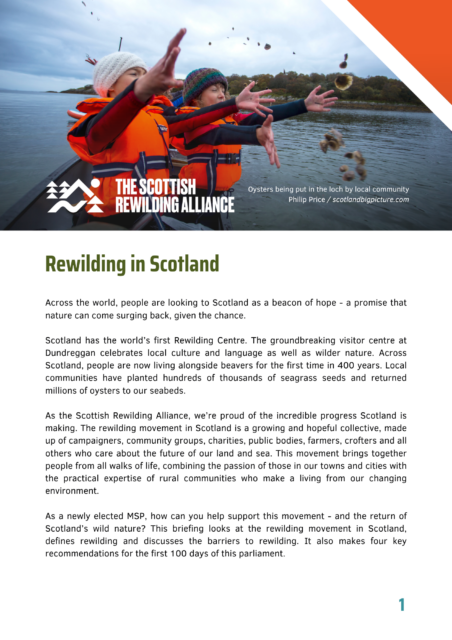
Scotland has the world’s first Rewilding Centre. The groundbreaking visitor centre at Dundreggan celebrates local culture and language as well as wilder nature. Across Scotland, people are now living alongside beavers for the first time in 400 years. Local communities have planted hundreds of thousands of seagrass seeds and returned millions of oysters to our seabeds.
As the Scottish Rewilding Alliance, we’re proud of the incredible progress Scotland is making. The rewilding movement in Scotland is a growing and hopeful collective, made up of campaigners, community groups, charities, public bodies, farmers, crofters and all others who care about the future of our land and sea. This movement brings together people from all walks of life, combining the passion of those in our towns and cities with the practical expertise of rural communities who make a living from our changing environment.
As a newly elected MSP, how can you help support this movement – and the return of Scotland’s wild nature?
This briefing looks at the rewilding movement in Scotland, defines rewilding and discusses the barriers to rewilding. It also makes four key recommendations for the first 100 days of this parliament.
Introduction
Rewilding works. It works for people and it works for nature.
In Scotland, a growing body of evidence demonstrates the positive impact that rewilding has on local economies and ecosystems.
- Projects in Rewilding Britain’s Rewilding Network saw a 412% increase in jobs.
- Rewilding Denmarkfield recorded 116 times more bumblebees in just 2 years.
- Wetlands created by beavers have 19% more species than other types of wetland.
- The reintroduction of white-tailed sea eagles generates over £4.9 million on Mull each year, supporting at least 98 jobs and £2.1 million of local income.
- Across Northwoods Rewilding Network sites, bird species have increased by 261%, nectar-rich plants by 250% and pollinators have seen a tenfold increase.
- Seawilding have returned over 350,00 native oysters to Loch Craignish.
- Protecting Loch Carron from destructive fishing practices has allowed the full recovery and expansion of its flame shell beds.
- Muddy seabeds protected from damaging fishing are home to twice as many species.
By 2030, Scotland has pledged to become nature-positive, restoring its natural environment and halting biodiversity loss. But we have a long way to go: Scotland is one of the most nature-depleted countries in the world. Currently less than 3% of Scotland’s land and less than 1% of its seas are rewilding.
Rewilding 30% of Scotland can be achieved by restoring habitats including peatlands, native woodlands, wetlands, rivers and seas, while maintaining and benefitting productive farmland. Rewilding can catapult us towards being a nature-positive country.
What is rewilding?
Put simply, rewilding is the large-scale recovery of nature, on land and at sea. By allowing nature to lead and adapt, natural processes – grazing, flooding, natural disturbance – can reshape ecosystems. Rewilding is about learning from the past but focusing on the future. It’s not about turning back the ecological clock – it’s about allowing it to start ticking again.
Rewilding encourages a balance between people and the rest of nature so we can thrive together. By creating healthy ecosystems and living in balance with nature, you create benefits for humans too. We all rely on nature for water, food and air as well as our own health and wellbeing. By restoring natural processes, rewilding builds more resilient ecosystems that protect our environment and communities against a changing climate.
Rewilding activities can include expanding natural woodlands, restoring wetlands and connecting up local habitats. It can also mean reducing pressure on marine habitats and planting seagrass or restoring oysters. It can involve bringing back missing species or reinforcing important species – from leeches to lynx. People are central to all of this work.
“Scotland could have more forests, healthier seas, and lusher wildlife. Rewilding is how we can make that happen – bringing with it balance, hope, and fantastic opportunity – creating jobs, teaching new skills, and bringing people together to look after Scotland’s future.” Alan Cumming
Scotland’s rewilding movement
Long before the term rewilding was popularised, grassroots groups and visionaries have been working to restore Scotland’s degraded natural environment. Frank Fraser Darling surveyed the Scottish Highlands in the 1940s and concluded that they had been emptied of both people and nature. Finlay MacRae, head forester at Glen Affric, saw new generations of pines springing up when protected from overgrazing in the 1960s. In the 1980s, divers noticed a collapse in biodiversity around Scotland’s coasts in the wake of the removal of the three-mile limit on bottom trawlers and decided to act.
The founding of initiatives like COAST in the 1990s and Trees for Life in the 1980s was a turning point for Scotland’s seascapes and landscapes. The Borders Forest Trust began restoring ecosystems at scale in the South of Scotland from 2000. The Langholm Initiative created the 4,000 hectare Tarras Valley Nature Reserve in 2021 to focus on community regeneration, nature restoration and climate action.
Today, there are around 200 rewilding initiatives across Scotland. Three-quarters of Scottish people support rewilding and want to see policies in place to help Scotland’s nature thrive. Our aim is simple: to create healthy, self-sustaining nature-based economies that support wildlife and provide lasting benefits for people living nearby. We want nature and communities to grow stronger together.
“My journey to see how rewilding can help nature and people thrive together was life-changing and such a source of hope. Like many young people, I’m worried about the uncertain future we all face with climate breakdown and nature loss – but life can bounce back if we give it a chance, and work with nature instead of against it.” Flo Blackbourn, star of Why Not Scotland?
4 ways to a wilder future
Rewilding is essential national infrastructure, ensuring our ecosystems can cope under the strain of nature loss and climate breakdown. Food production, clean water and our health and wellbeing all depend on healthy ecosystems. For too long, ecosystem resilience has been marginalised by decision makers. This creates uncertainty and holds back the recovery of our natural environment – itself an effective tool for building climate resilience. It limits our understanding of how ecosystems are responding to climate breakdown. And it means that the large-scale recovery of nature is underfunded as well as inappropriately funded.
To put ecosystem restoration at the heart of every national decision, the Scottish Government should appoint a Nature Minister.
During this parliament, Scotland’s statutory nature recovery targets will be created. To address the nature emergency, we need robust and clear nature recovery targets that address the underlying factors causing our nature to decline. We want you to set ambitious targets for the strengthening of indicator species, the ability for wildlife to move across connected landscapes and seascapes, and the restoration of degraded ecosystems.
We call on all parties to commit to legally binding nature recovery targets that support ecosystem recovery.
Funding for nature restoration is often short-term, competitive and bureaucratic. Community initiatives to restore oysters and seagrass need to be able to offer secure, local jobs. Farmers interested in hosting beavers on their land need to know they won’t experience financial penalties. Landowners who want to see ecosystems recover at scale need financial certainty. Nature needs both capital and revenue funding that allows land managers and landowners of all sizes and types to rewild, at scale.
To secure healthy ecosystems for future generations, we propose a tripling of the Nature Restoration Fund and a fundamental reform of the rural payments system.
Whether it is red squirrels burying nuts that grow into trees, beavers building dams that create wetlands or oysters stacking themselves into reef habitats, returning keystone species can accelerate nature restoration. But the bureaucratic licensing system makes this very hard to achieve. We need a commonsense approach to licensing that enables the reintroduction of species to areas where they will have the greatest benefit, while ensuring any potential problems can be managed.
We support a modernised licensing framework that enables the return of keystone species, helping to create healthy ecosystems.
Where you can find out more
- Watch our campaign film Why Not Scotland? on our YouTube channel
- Read about the amazing projects that are part of the Northwoods Rewilding Network and Rewilding Britain’s Rewilding Network
- Sign up to the British Ecological Society’s Rewilding Special Interest Group newsletter
- Explore Rewilding Europe’s accessible and interactive free online rewilding course
- Check out the Global Rewilding Alliance’s Research Library
About us
In 2019, the Scottish Rewilding Alliance was formed to bring together organisations and campaigners who share the goal of helping nature recover and thrive across Scotland. Together, we are building a sustainable movement for rewilding Scotland. We believe the best way to do this is by working in partnership with communities, local communities, interest groups, and the government.
Our members fight for wilder nature in their local areas as well as across Scotland. We use powerful stories and clear evidence to advocate for policy solutions that support nature’s recovery.
Our aim is simple: to create healthy, self-sustaining nature-based economies that support wildlife and provide lasting benefits for people living nearby. We want nature and communities to grow stronger together.