
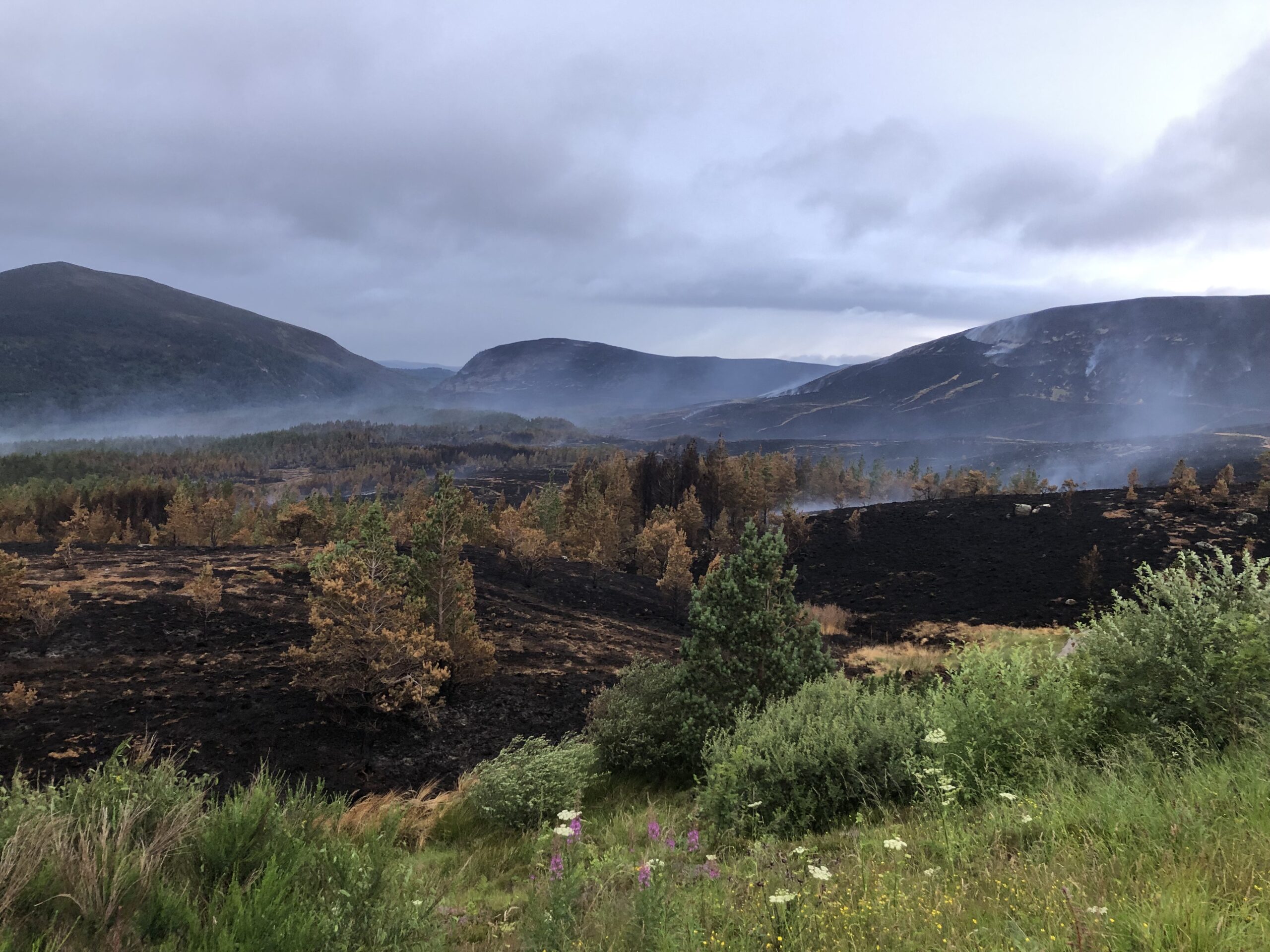
The Scottish Rewilding Alliance expresses its deep gratitude to the Scottish Fire and Rescue Service, other emergency responders, conservation staff, farmers, gamekeepers, pilots, land managers, local businesses and community volunteers helping to fight the wildfire in the Cairngorms. The collective effort from those on the ground to limit the impact on people and nature is humbling – and reminds us that we can pull together to tackle grave situations.
We hope that the situation continues to improve.
A community appeal supporting response and recovery efforts on the ground can be supported through the Support for Cairngorm Wild Fires GoFundMe:
https://www.gofundme.com/f/support-for-cairngorm-wild-fires
Please note that this fund is entirely independent of the Scottish Rewilding Alliance and our members and we will not receive any income from it.
When dry weather turns our hills and moors into tinderboxes, we hand our emergency services and land managers an almost impossible task if we do not prevent fires from starting in the first place.
The vast majority of wildfire ignitions stem from avoidable human actions, such as disposable barbecues, discarded cigarettes, campfires, littering, or irresponsible burning during dry weather. Stopping these ignitions through an urgent national push on public education must be Scotland’s immediate priority.
Investment in our capacity to respond quickly to wildfires is also urgent. The UK and devolved governments must come together to equip emergency services and land managers with the tools they need to stop fires in their earliest stages.
Beyond that, to protect our landscapes in the longer term, we must improve our understanding of how wildfires burn. Wildfire research is a growing area of interest and there is much still to learn about how different land management regimes across Scotland affect the likelihood, severity and impact of fire. But evidence suggests that the primary driver of Scotland’s worst wildfires is extreme dryness rather than simple ‘fuel load’: dry vegetation ignites regardless of how it is managed, whereas wet, healthy ecosystems naturally resist burning.
Independent analysis of the 2025 Carrbridge-Dava Moor classified the blaze as the UK’s first megafire. It also revealed that 85% of carbon emissions came not from surface heather, but from dry peat burning deep underground. When shallow peats, slopes, and soils dry out, they act as fuses, carrying surface fire deep into the earth.
To support our frontline responders and protect communities in a warming climate, Scotland must work at a catchment scale to re-wet key landscape features and create natural firebreaks. By blocking old drainage, restoring peatlands and establishing rich riparian habitats, we can hold water in our landscapes for longer.
Active beaver wetlands create green, moisture-rich buffers that help limit the spread of fires, giving those on the frontline a fighting chance to contain blazes before they turn into megafires. They also act as vital refuges for wildlife fleeing the fires.
Expanding native broadleaf woodlands offers another proven defence. Research shows that swapping flammable monocultures for diverse broadleaf species can cut fire intensity by up to five times, creating natural barriers that slow a blaze’s spread.
Research demonstrates that grazing by a mixed guild of herbivores – including hardy native cattle, native ponies, wild boar and wild deer at suitable densities – can also prevent and mitigate wildfires. Free-roaming, low-density herbivores create a patchy mosaic of habitats, with trampling, wallowing, and heavy grazing creating natural, irregular firebreaks across the landscape.
We need wetter, more resilient landscapes using every tool at our disposal – before the next megafire ignites.