
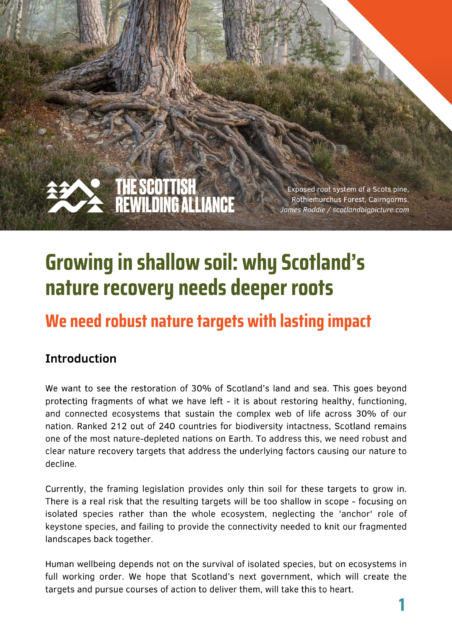
Growing in shallow soil: why Scotland’s nature recovery needs deeper roots
We need robust nature targets with lasting impact
Introduction
We want to see the restoration of 30% of Scotland’s land and sea. This goes beyond protecting fragments of what we have left – it is about restoring healthy, functioning, and connected ecosystems that sustain the complex web of life across 30% of our nation. Ranked 212 out of 240 countries for biodiversity intactness, Scotland remains one of the most nature-depleted nations on Earth. To address this, we need robust and clear nature recovery targets that address the underlying factors causing our nature to decline.
Currently, the framing legislation provides only thin soil for these targets to grow in. There is a real risk that the resulting targets will be too shallow in scope – focusing on isolated species rather than the whole ecosystem, neglecting the ‘anchor’ role of keystone species, and failing to provide the connectivity needed to knit our fragmented landscapes back together.
Human wellbeing depends not on the survival of isolated species, but on ecosystems in full working order. We hope that Scotland’s next government, which will create the targets and pursue courses of action to deliver them, will take this to heart.
Nature recovery targets
We would have liked to see nature recovery targets that related to keystone species, ecological connectivity and the restoration of natural processes. We hope that the targets themselves will address the underlying factors that are causing the decline of Scotland’s nature, setting ambitious targets for the strengthening of indicator species, the ability for wildlife to move across connected landscapes and seascapes, and the restoration of degraded ecosystems.
We support amendment 22 in the name of Beatrice Wishart MSP to strengthen the biodiversity duty for public bodies by linking their work to the new statutory targets.
We support amendment 23 in the name of Lorna Slater MSP to align the setting of targets with the Convention on Biological Diversity, in addition to the Scottish Biodiversity Strategy.
We support amendment 27 in the name of Mark Ruskell MSP to replace a statement on costs with a statement on how approaches to meeting targets will be funded.
Environmental impact assessment and habitats regulations
The Natural Environment Bill as originally drafted included enabling powers that would better allow for future amendments to Scotland’s Environmental Impact Assessment (EIA) regimes and Habitats Regulations. As drafted, these powers were far too extensive in reach, using a sledge hammer to crack a walnut, but it still remains that a proportionate tool to crack the walnut is required. A consultation took place on this in 2024.
Our decades-old system of land designations (SSSIs, SACs) is no longer the right tool for large-scale nature recovery. In some cases, regional NatureScot staff are able to apply flexibility to allow some landowners to pursue ambitious nature recovery goals. Elsewhere, a rigid approach to designations has been taken and, in some cases, this has held back nature recovery. For example, land managers being required to remove naturally regenerating woodland from their land because the site is designated for heath rather than woodland. Designation constraints have even directly conflicted with funding criteria, preventing projects from accessing support.
Current designations do not adequately recognise ecosystem-scale restoration, meaning that initiatives designed around designations risk excluding some of the most important areas for nature recovery. We are disappointed to see that the Scottish Government is not bringing forward a more proportionate and tailored revised Part 2 at Stage 3, and is removing this from the title of the bill via amendment 44.
Producing guidance on the application of designations would be welcome. We therefore strongly support amendment 31 in the name of Mark Ruskell MSP, but would like to see future work undertaken on reviewing and modernising these designations as well. We need a commitment to review and modernize designations, shifting the focus from preserving a snapshot of the past to enabling the natural processes of the future. This relates only to terrestrial designations and nature recovery.
We also support amendment 31B in the name of Rhoda Grant MSP mandating an independent working group be part of producing the guidance. We hope that groups whose focus is restoration and large-scale nature recovery should be part of any independent working group.
National parks
Scotland’s national parks should be trailblazers when it comes to nature recovery, pioneering new approaches, working with stakeholders and exploring how communities can participate in and benefit from nature’s return. To empower them to do so, it is vital that this mission is clear and understood by those working for, and with, our national parks.
In a paper submitted to NatureScot’s National Park Stakeholder Advisory Group in 2022, three options for change were outlined. Minor change; significant change; and step change. Despite the need for urgent action and the potential of our national parks to help tackle the dual nature and climate crises, the Scottish Government has selected the minor change option. We believe that the government’s decision to drop the proposed overarching purpose for Scotland’s national parks, which the majority of stakeholders supported in the consultation, will have damaging consequences for nature. NatureScot’s advice to ministers in February 2023 said that in the consultation, “There was strong and widespread support across respondent categories for “leadership of nature recovery and a just transition to net zero” to become the overarching purpose of Scotland’s National Parks.”
Scotland is beginning its journey towards nature recovery from a low baseline – protecting areas that are already degraded is not sufficient. Scotland’s national parks are currently designated protected areas classified by the International Union for Conservation of Nature (IUCN) as a Category V protected landscape or seascape. Over half of the park area in the Cairngorms National Park is protected by a specific landscape designation. Loch Lomond and the Trossachs National Park has 73 designated special nature conservation sites and 60 Sites of Special Scientific Interest. Approximately a fifth of these sites are not in a favourable condition according to current monitoring data and techniques. The draft Bill fails to send a clear signal that our national parks are expected to lead in tackling the nature emergency.
Deer management
Overabundant deer populations can suppress natural regeneration, damage woodlands and reduce biodiversity. Promoting wild venison in our diets supports population management of deer.
Establishing a national food chain of wild venison would introduce additional protein into our diets and a source of locally produced protein to communities. Venison has approximately a third of the fat found in beef and is significantly lower in cholesterol, whilst at the same time containing more protein and essential amino acids.
We support the production of a plan about the management of deer and the promotion of venison in Scotland. Amendment 20 in the name of Jim Fairlie MSP requires the Scottish Government to produce a national deer management and venison plan, including a statement of priorities, measures and actions the government intends to take in relation to lowland deer management, emerging concern, the venison industry and financial support for deer management. It should also set out relevant data in relation to deer management.
While human culling and venison production are vital tools, long-term deer management should also look toward the restoration of natural processes. The return of the lynx – a specialist predator of roe deer – would provide a ‘precision tool’ for managing deer populations in hard-to-reach woodlands, helping to restore the balance that has been missing for centuries.
We also support:
- Amendment 20A in the name of Mark Ruskell MSP, which clarifies the data needs in relation to a national deer management plan
- Amendment 20B in the name of Mark Ruskell MSP, which requires the plan to include polices and proposals, including funding, for meeting cull targets
- Amendments 20C and 20D in the name of Tim Eagle MSP, which requires the plan to include a pilot for community larders and wider processing infrastructure to increase production capacity for venison
- Amendment 20E in the name of Mark Ruskell MSP, which adds the environmental and nature restoration sector to consultees when preparing a national deer management plan
Access to justice is a critical factor in restoring Scotland’s nature. Scotland is currently in breach of Article 9 of the Aarhus convention, which requires access to environmental justice to be ‘fair, equitable, timely and not prohibitively expensive.’ Amendment 50 in the name of Rhoda Grant MSP advances environmental justice in relation to deer management.
We support the introduction of a deer management dashboard via amendment 59 in the name of Beatrice Wishart MSP.
Marine recovery
Over a decade of delays have seen Scotland’s inshore waters and coastal communities denied any hope of recovery. The recent cancellation of the long-overdue consultation on inshore Marine Protected Areas and Priority Marine Features is the latest in a series of vanishing promises. At Stage 2 of the Natural Environment Bill, marine amendments were rejected on the grounds that existing legislation and strategies are already in place. Yet these existing plans are often at cross-purposes, work in isolation from each other and are not delivering meaningful change.
The Natural Environment Bill must mention the marine environment specifically. We need nature recovery targets and actions that address the urgent need to restore our seas.
We strongly support amendment 66 in the name of Ariane Burgess MSP, which requires the government to set a target that restricts demersal mobile fishing gear in at least 30% of Scotland’s inshore waters. Fishing gear that makes contact with the seabed disturbs important habitats such as seagrass, kelp, maerl and oyster, impacting on the species that live and breed in these habitats. By restricting destructive fishing gear in at least 30% of inshore waters, where most key habitats for the spawning and nursing of fish populations are, populations of commercially and ecologically important species can recover – benefitting biodiversity, sustainable fishing and coastal communities.
Particularly following the delay of the consultation on the management of inshore Marine Protected areas and Priority Marine Features, this amendment would be key to ensuring the huge gap in management of damaging fisheries in Scotland’s inshore waters is addressed. This amendment would ensure that at least 30% of waters are safeguarded for fishing practices compatible with the rewilding of our seas, protecting the heritage and local economies of our coastlines.
We support amendment 142 in the name of Sarah Boyack MSP. Connecting the National Marine Plan to the statutory nature recovery targets is critical to ensure consistency and coherence across frameworks. The National Marine Plan is currently too often enabling a first-come, first-served approach instead of supporting the strategic and holistic planning that would enable the sustainable use of Scottish seas.
We support amendment 143 in the name of Sarah Boyack MSP. The impacts of damaging fishing practice on natural processes and ecosystem services must be acknowledged so it can be managed properly. Recent findings highlight the significance of the seabed for the capture and storage of carbon dioxide. Safeguarding our country’s greatest carbon store is key in the fight against climate breakdown.
Amendment 145 in the name of Sarah Boyack creates low-impact fishing priority areas. This is critical to the future of fragile rural communities, who are outfished by larger boats with damaging gear. By designating certain areas of Scottish inshore waters as low-impact fishing areas, fishers using methods that minimise damage to the marine environment can better support themselves and their communities. Pressure on fish populations and sensitive habitats in low-impact fishing areas will be reduced, enabling recovery – including of fish stocks.
We support amendment 146 in the name of Sarah Boyack MSP. The current marine policy framework in Scotland is complex, too often considering activities and developments in a siloed manner. The targets it has set have been continuously ignored or delayed – perhaps most notably, the achievement of Good Environmental Status under the Marine Strategy Framework Directive. Developing a bespoke strategy coordinating a holistic approach to marine recovery with an associated roadmap or indicators to measure progress would be a very powerful tool to set Scotland on a path to wilder seas.
Environmental farming schemes
We support amendment 156 in the name of Jamie Halcro Johnston MSP. With pressure on public funding to deliver for nature and a just transition, reporting on the effectiveness of environmental farming schemes is essential.
Wildlife coexistence
We support amendment 168 in the name of Tim Eagle MSP, because we agree that a sensible, well-designed wildlife coexistence fund would support the return of iconic species to Scotland. However, we recommend that the fund be created through a participatory co-design process, following best practice examples from countries that have already pioneered such approaches. We would also like to see the Scottish Government invest in guidance, education and knowledge exchange on human-wildlife coexistence, including inter-generational programmes and farmer-to-farmer networks.